



In today’s digital age, startups face fierce competition in the online marketplace. They must leverage the power of digital marketing analytics to stay ahead of the game. By tracking and analyzing key metrics, startups can gain valuable insights into audience behavior, campaign performance, and overall marketing success.
Whether you’re a beginner or a seasoned pro, mastering the art of digital marketing analytics can help you:
- optimize your campaigns
- improve your ROI
- achieve long-term success
However, with so many metrics and analytics tools available, it can be difficult for startups to know where to start. This article will walk you through the essential metrics to track. We will also show you how to set up and analyze data using popular analytics tools.
What is Digital Marketing Analytics, and Why is it Important for Startups
It’s not enough for startups to have a great product. They must also market effectively and know how to target their audience for maximum success – that’s where digital marketing analytics comes in.
Digital marketing analytics is an invaluable tool for startups. It provides:
- critical insights into customer behavior
- marketing campaign results
- performance of marketing initiatives
- understanding of what content appeals most to customers
By tracking the effectiveness of campaigns, the analytics give businesses the edge in improving marketing ROI and brand awareness.
Overall, utilizing digital marketing analytics helps startups identify market trends and make decisions based on data-driven insights to improve their bottom line.
Identifying the Metrics that Matter in Digital Marketing Analytics
For startups, digital marketing analytics is a critical resource for measuring success and identifying opportunities for improvement. But what exactly do you measure? Picking and tracking the right metrics can make the difference between achieving your goals and failing.
Metrics that matter in digital marketing analytics include:

 Customer satisfaction and loyalty
- Website visits (Web traffic)
- Advertisement impressions
- Conversion rates
- Customer lifetime value (CLV)
- Return on investment (ROI)
- Search engine rankings
- Sales
These metrics provide insights into which strategies work best or worst so you can adjust accordingly. Even with limited resources, monitoring these key performance indicators is possible. This monitoring, in turn, allows startups to make informed decisions and spend wisely on marketing to get the best results. Let’s look at the most important metrics in detail.
Web Traffic
This metric shows the number of visitors to a website. By tracking website traffic, startups can see how many people discover their brand and engage with their content.
Check two types of data in Google Analytics 4: “Users” and “Sessions.” The “Users” field shows how many people visited your website. The “Sessions” metric shows how often someone has visited your site. If the same person repeatedly visits your site, each visit counts towards Sessions number but not toward Users.
Regarding startups, having insight into web traffic is essential for success. Analyzing which pages are more popular than others, understanding patterns in user behavior, and measuring the effectiveness of landing pages can help give decision-makers a detailed overview of the site’s performance. This lets you invest more in profitable pages and user flows and improve your site content to drive more sessions.
With the right analytics platform in place, you will gather valuable data that can impact the business’s direction in the future.
Conversion Rate
Conversion rate measures the percentage of website visitors who take a desired action. You can set your conversion tracking to be triggered by a specific action, for example:
- a demo request
- a purchase
- filling out a form
- subscribing to a newsletter
This metric is crucial for startups to track because it shows how effectively their website turns visitors into customers. By measuring customer behavior from initial engagement to final conversion, a startup can identify areas for improvement to convert more customers and ultimately increase revenue.
Use analytics to measure user flows and view performance trends for all parts of your sales funnel to determine where changes are needed. Identify the most effective combinations of page layout, content, design elements, and pricing structure; understand what makes a successful conversion rate and apply it to all your pages.
You may track conversions by creating custom events in Google Analytics 4. To do this, go to Admin – Property Settings – Events.
User Engagement
Analytics lets companies track how their customers interact with their products or service, and find ways to improve user experience, increasing customer loyalty and revenue. For this, user engagement is one of the most important indicators. It compiles from several factors:
Time on Site
The average time visitors spend browsing the website pages. Find this data under the “Average engagement time per session” in Google Analytics 4.
Pages per Session
The average number of pages visitors view during a single session on a website.
Scroll Depth
Measures how far down a page visitors scroll. This metric can be found in the list of events in Google Analytics 4.
Bounce Rate
Measures the percentage of visitors who leave a website after viewing only one page. In Google Analytics 4, a session is categorized as a bounce if a user interacts with only one page during the session and generates no further pageviews or events. It’s important to note that a high bounce rate doesn’t necessarily indicate poor performance, as there may be instances where users find all the information they need on the landing page and leave the site without taking any further actions.
Click-Through Rate (CTR)
Measures the percentage of clicks a link or call-to-action receives compared to the number of times it was shown. This metric often measures engagement with digital ads or email campaigns.
Social Media Engagement
The number of likes, comments, shares, and followers. These metrics can help startups understand how their social media content resonates with their audience and identify opportunities for improvement. Social media platforms such as Facebook, Twitter, and Instagram provide built-in analytics tools for tracking engagement.
To evaluate a startup website’s effectiveness and success and continually develop and refine it, it’s crucial to understand when and why users engage with it. Analytics show user trends to help make data-driven decisions on optimizing brand growth.
Analyzing the Data and Turning it into Actionable Insights
Startups require data analytics to understand the performance of their products and teams truly. Analyzing the data gives mission-critical insights that can be used to identify weaknesses and strengths. It allows leaders to take action and make weighed decisions.
With a focus on streamlined and efficient approaches, startups often turn to specialized analytics platforms to gather information quickly and efficiently. By ensuring that all of the collected data is easily accessible, it becomes easier for all team members in a startup environment to access, review, analyze, and then use it.
Measuring ROI on the Digital Marketing Spend

For startups looking to maximize their return on investment from digital marketing spending, tracking key metrics such as Cost per Acquisition (CPA) and Customer Lifetime Value (CLV) is crucial. These metrics provide a holistic view of ROI and can help businesses optimize their digital marketing efforts to increase profits.
CPA is calculated by dividing a company’s sales cost by the number of conversions, providing insight into how much it costs to acquire each customer. This metric is essential for startups that need to be cost-effective and therefore know exactly how much it costs them to win a new user.
On the other hand, CLV measures the long-term value of a customer to a company. By analyzing customer revenue over their lifetime, startups can identify which customer segments are most profitable. This metric helps companies adjust digital marketing strategies to increase customer retention and satisfaction.
By measuring CPA and CLV together, startups can optimize their ROI. A way to do it is to increase profits by reducing acquisition costs and increasing customer value while minimizing digital marketing spending.
Streamline Digital Marketing Analytics Processes With These Tools
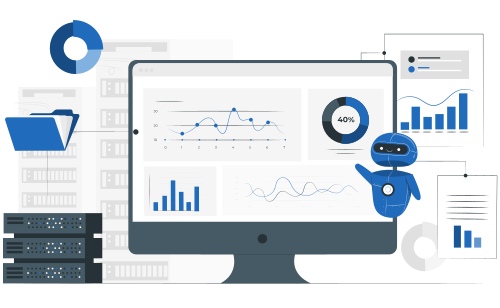
Automation tools are increasingly being used to streamline and enforce digital marketing analytics processes. Incorporating these tools can save time, improve accuracy and provide deeper insights.
There are several tools available to streamline digital marketing analytics processes for startups. Here are a few examples:
Google Analytics
This free tool is one of the world’s most widely used analytics platforms. It gives startups valuable insights into website traffic, user behavior, and conversion rates. Google Analytics offers customizable dashboards, reports, and alerts, making it an excellent tool for startups looking to streamline their analytics processes.
Google Analytics Universal, which was widely used in the past, has been deprecated and is no longer recommended for new users. GA4 is the next-generation analytics tool and offers several benefits over its predecessor, including cross-device tracking, event-based data tracking, and more.
Mixpanel
This tool offers advanced analytics and user-tracking capabilities for mobile and web applications. Mixpanel allows startups to measure user engagement, retention, and conversion rates and provides insights that can help businesses optimize their marketing and product strategies.
Hotjar
This all-in-one analytics and feedback tool allows startups to see how users interact with their websites through heatmaps, session recordings, and feedback polls. Hotjar offers valuable insights into user behavior and can help businesses identify areas for improvement on their website.
HubSpot
This marketing and sales platform offers a variety of tools, including analytics and reporting, to help startups streamline their marketing processes. HubSpot provides insights into website traffic, conversion rates, lead generation, and tools for email marketing, social media management, and more.
Ahrefs
An all-in-one SEO tool that offers a suite of features, including keyword research, backlink analysis, content marketing, and more. Ahrefs provides startups with insights into competitor analysis, website traffic analysis, and keyword ranking, making it an excellent tool for businesses looking to streamline their digital marketing analytics processes.
Clarity
A free web analytics tool lets businesses see how users interact with their websites through heatmaps, session recordings, and funnels. Clarity also offers features such as click maps, scroll maps, and session replays that can help businesses identify areas for improvement on their website. Additionally, Clarity provides detailed analytics reports, including metrics such as unique visitors, bounce rates, and session duration, allowing businesses to make data-driven decisions to optimize their digital marketing strategies.
By utilizing tools such as GA4, Mixpanel, Hotjar, HubSpot, Ahrefs, and Clarity, startups can gain valuable insights into user behavior, website performance, and marketing effectiveness, helping them to maximize their return on investment from digital marketing spending.
Integrating Automation AI Tools
An automation tool like an analytics dashboard is a great way to
- track key performance indicators related to your campaigns,
- identify potential opportunities
- alert team members to any issues.
Automating the analysis process with AI technology helps marketers focus on strategy and creative planning while keeping their campaigns within budget.
This improved efficiency also gives marketers more resources and capacity to face new challenges that arise in the ever-changing landscape of digital marketing.
In conclusion
Digital marketing analytics is an incredibly powerful tool for startups to benefit their businesses and get ahead of the competition. It enables them to measure, analyze and evaluate data relating to web traffic, conversion rate, user engagement, and ROI of their spending on digital campaigns.
Vast knowledge lets startups make better decisions that will result in a higher return on investment in digital marketing. By understanding the right metrics, analyzing the data collected to make actionable insights, and using automation tools, you can thoroughly understand your users’ behaviors and interests to drive your startup’s growth and success.